News
From Zero to 90 Wagons in 10 Days
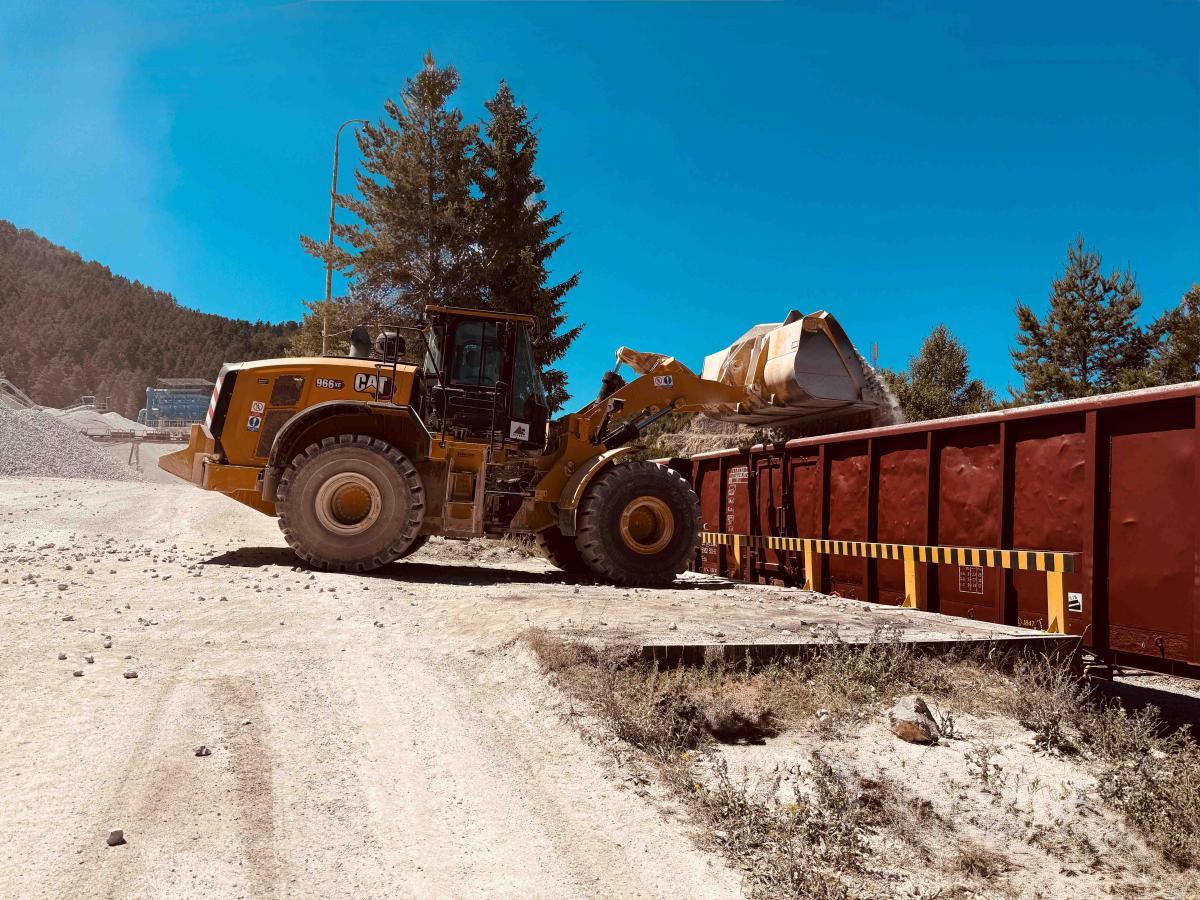
After more than two decades of silence, the signals in Olcnava are shining again. The siding of the quarry of KSR - Kameňolomy SR, s.r.o. (part of the STRABAG group) has been brought back to life after technical and operational preparations – and ZSSK CARGO managed to move the first 90 wagons from there to customers in Poland within just ten days. This return to rail is not a nostalgic story but a practical response to market demand of an ecologically thinking company and real logistics needs.
Return of the Siding After Two Decades
In the 1990s and early 2000s, it was common for the Olcnava quarry to dispatch groups of wagons for various construction projects. Gradually, however—mainly because of the short distances typical of aggregate transport within Slovakia—road haulage took over, and the siding became idle. Meanwhile, circumstances have changed: suitable aggregate sources for railway and other infrastructure projects in Slovakia are dwindling, while demand is rising in neighbouring countries—particularly in Poland, where intensive road, rail, and infrastructure renewals are underway.
The decision to revive the siding therefore fits into a broader logistics picture. The STRABAG group has long favoured transport solutions with a lower carbon footprint, and rail can move large volumes efficiently and safely. ZSSK CARGO’s task was clear: prepare the technology, organize the capacities, and deploy the rolling stock to achieve regular operations in a short time from a standing start.
The First Ten Days: A Loading Rhythm
Operations began with a clear rhythm. The siding accommodates 15 wagons and one locomotive, with a total train length not exceeding 230 meters. The consist is always pushed onto the siding from the Markušovce station. Each wagon takes around ten minutes to load; fifteen wagons thus require roughly three to four hours of pure loading time. Once filled, the train moves to Spišské Vlachy, where two sections are coupled into one train ready for departure under electric traction—the most environmentally friendly mode.
This simple yet precise rhythm allowed the dispatch of the first 90 wagons in just ten days. The initial shipments totalled around 5,000 tonnes of material—an amount that would otherwise have required hundreds of truck journeys.
Logistics on a Corridor: Why Olcnava Is Different
Olcnava’s siding is unique because it connects not to a station but directly to a busy mainline corridor with frequent passenger services. Servicing it is not for everyone—it requires local knowledge, precise coordination within the ŽSR network, and the ability to operate within narrow time windows. Here, ZSSK CARGO’s domestic experience proved essential—from shunting coordination to integrating the trains into the timetable so the cargo could continue safely and punctually to its destination.
Market Signals: Foreign Demand and Domestic Potential
The direction of the first trains reflects where demand is strongest today. Poland is undergoing extensive modernization of its transport and industrial infrastructure, maintaining a steady need for aggregates. For customers, reliability and volume are key—and in these parameters, rail has a natural advantage. For KSR - Kameňolomy SR, s.r.o. (STRABAG), this also means delivering material with a lower carbon footprint.
Demand for Slovak raw materials abroad is evident. Recent examples include new aggregate transports from the Gemer region to Hungary and Romania. Within Slovakia, several infrastructure projects also present potential for greater rail involvement. For example, ZSSK CARGO has supplied cement from the Považie region to the R2 expressway construction, and opportunities exist for the D3 highway in Kysuce region. KSR, which operates seven quarries in Slovakia, regularly uses rail to supply track modernization projects—even without sidings—such as shipping track ballast from the Husiná quarry to loading in Fiľakovo station or from Lehota pod Vtáčnikom to Bystričany station. From these stations, engineering trains with ballast head to corridor modernization sites.
Effects on Roads and Emissions
This first business step—about 5,000 tonnes moved by rail—replaced some 200 one-way truck hauls that would have crossed Slovakia toward inland Poland. Fewer heavy vehicles mean less wear on roads and lower emissions per tonne transported. Over longer distances, the difference becomes even more pronounced, making rail the more rational choice both economically and environmentally.
Fleet and Operations
ZSSK CARGO deployed what this type of transport requires: experienced crews, shunting and mainline locomotives licensed for both Slovakia and Poland, and sufficient high-sided Eas wagons—freed up after the decline in coal transport and structurally well-suited for aggregates. This combination of rolling stock capacity and procedural expertise enables direct delivery to the customer without unnecessary transloading.
Safety and Procedures: The First Meters Under Supervision
Reactivating the siding involved more than clearing the tracks. Every railway worker must first familiarize themselves with the KSR - Kameňolomy SR, s.r.o. Olcnava siding’s Operating Rules, available directly at the quarry. Entry and exit follow the “Description and Operation of the Siding” document prepared by ŽSR. For the first loaded train, STRABAG Rail’s technical support was present to monitor both empty and loaded train movements. Safety was the top priority—from correct wagon positioning at the ramp to clear signaling and communication between driver, shunter, and loader. All parties involved treat safety as the cornerstone of cooperation.
Risk Factors
External conditions can accelerate or slow projects like this. The Slovak government’s proposed fiscal consolidation measures—specifically, additional levies on each tonne of extracted material—would reduce domestic producers’ competitiveness internationally. In a market where transports often cross borders and compete for sources from several countries, such measures could be decisive, especially given the potential demand—over twenty times greater than the current transported volumes.
Broader Context: Slovakia’s Unused Sidings
Roughly half of Slovakia’s existing railway sidings are currently active. Reactivating those that already exist physically is the quickest way to shift more freight from roads to rails without lengthy permitting processes or new construction. Olcnava shows that even after long dormancy, it is possible to resume operations relatively quickly provided there is demand, a prepared loading site, and an experienced carrier.
Incidentally, reactivating a siding can be worthwhile even without loading volumes. In times of downturn in European rail freight, siding owners may find it useful to use their tracks as storage space for temporarily idle wagons.
What Comes Next
The first days set the rhythm and demonstrated scalable capacity. The project’s potential toward Poland is many times higher.
ZSSK CARGO is ready to maintain transport continuity, provide ongoing wagon allocation, and adapt to customer needs. After years of silence, Olcnava once again measures time in minutes and tonnes—and the train makes sense.
For information about transporting construction materials by rail, or for siding activation and launching environmentally friendly rail freight, contact the relevant commodity or regional sales manager at ZSSK CARGO: https://zscargo.sk/kontakty/obchodni-manazeri